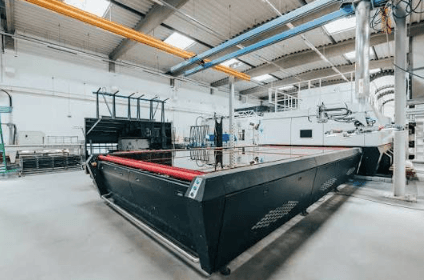
Advanced Glass Tempering Technology: Improving Quality and Production Efficiency
The glass processing industry has changed significantly as manufacturers look for faster, more reliable, and more precise production methods. Modern architectural, automotive, and specialty glass applications often require products with consistent dimensions, improved strength, and carefully controlled surface quality. Achieving these results depends not only on the glass itself but also on the technology used during thermal processing.
Glass tempering is one of the most important processes in modern glass manufacturing. By carefully heating and cooling glass under controlled conditions, manufacturers can produce stronger products suitable for demanding applications. However, the quality of the final product depends heavily on equipment configuration, temperature management, roller systems, and production controls.
Understanding the Glass Tempering Process
Tempering involves heating glass to a carefully controlled temperature and then rapidly cooling its surfaces. This process changes the stress distribution within the glass and increases its mechanical strength compared with untreated glass.
The process requires precise control because temperature variations can affect the final result. Factors such as glass thickness, dimensions, composition, heating speed, and cooling conditions must be considered when establishing suitable production parameters.
Modern tempering equipment is therefore designed to provide consistent heating and cooling throughout the production cycle.
Why Heating Uniformity Matters
One of the most important considerations in glass tempering is uniform heating.
If different areas of a glass sheet receive significantly different amounts of heat, the final product may have variations in optical quality, flatness, or stress distribution. This becomes particularly important when processing large or specially shaped pieces.
Advanced heating systems can help manufacturers maintain more consistent thermal conditions. Better control of airflow, heating zones, and temperature settings can contribute to a more predictable manufacturing process.
Processing Curved Glass
Curved glass presents additional challenges compared with flat glass. Its geometry requires equipment capable of managing the material carefully throughout heating and forming.
The roller arrangement and furnace configuration need to accommodate the intended shape while maintaining controlled thermal conditions. Equipment designed specifically for curved processing can provide manufacturers with greater flexibility when producing glass for modern architectural and design applications.
Curved tempered glass can be used in a variety of projects where conventional flat panels may not provide the desired appearance or functionality.
The Role of Roller Systems
Rollers are another important part of a glass tempering system. They transport glass through different stages of the process while helping maintain its position and movement.
The roller design must be compatible with the type and shape of glass being processed. Consistent movement can help reduce unwanted variations and support stable production.
Manufacturers should therefore consider not only furnace temperature but also the mechanical system responsible for transporting the glass.
Automation and Production Control
Automation has become increasingly important in modern glass processing facilities.
Digital controls can allow operators to manage temperature settings, production parameters, conveyor movement, and other important functions from a centralized interface. This can simplify operation and make it easier to maintain repeatable production conditions.
Automated systems may also help reduce dependence on manual adjustments during routine production. However, operators still need appropriate training and knowledge to select and monitor the correct parameters for different glass types.
Supporting Consistent Product Quality
Consistency is particularly important when glass is produced for commercial projects involving large quantities of similar panels.
A reliable process can help manufacturers reduce variations between individual pieces. This is valuable when glass needs to match across a building façade, vehicle application, interior installation, or other large project.
Quality control should begin with raw glass inspection and continue through cutting, edge processing, washing, heating, tempering, inspection, and final packaging.
Choosing Equipment for Production Needs
There is no single equipment configuration suitable for every glass manufacturer.
A company should consider its typical glass dimensions, thickness range, production volume, product types, available floor space, and future expansion plans before investing in new machinery.
It is also useful to examine maintenance requirements, spare parts availability, operator training, energy consumption, and technical support.
A machine that matches the actual production profile can be more practical than choosing equipment based solely on maximum specifications.
Energy Efficiency Considerations
Heating glass requires substantial energy, making efficiency an important operational consideration.
Modern equipment can incorporate technologies designed to improve heat transfer and reduce unnecessary energy consumption. Proper insulation, optimized heating zones, and effective control systems may contribute to more efficient operation.
Energy performance should be evaluated together with production capacity and product quality rather than considered separately.
Maintenance and Long-Term Performance
Even advanced equipment requires regular maintenance.
Heating elements, rollers, sensors, electrical systems, cooling components, and control systems should be inspected according to the manufacturer’s maintenance recommendations.
Preventive maintenance can help identify developing problems before they cause extended production interruptions. Keeping accurate maintenance records can also help production teams plan servicing more effectively.
For manufacturers researching equipment for curved and specialty glass processing, EASTTEC Top Convection Curved Glass Tempering Machine with Hard Roller can be reviewed as one example of specialized tempering technology.
Frequently Asked Questions
1. Why is temperature control important in glass tempering?
Controlled temperature is essential because uneven heating can affect the consistency and quality of the finished glass. Different glass types and thicknesses require suitable processing parameters.
See also: Top Tech Trends to Watch in 2025
2. Can curved glass be tempered?
Yes, specialized equipment can be designed for curved glass processing. The appropriate machinery depends on the required dimensions, shape, thickness, and production requirements.
3. How can manufacturers improve tempering consistency?
Consistent raw materials, accurate temperature control, stable glass movement, proper equipment maintenance, and trained operators can all contribute to more consistent production.
Conclusion
Modern glass manufacturing requires a combination of material knowledge, thermal control, mechanical precision, and effective quality management. Advanced tempering technology can help manufacturers process increasingly sophisticated glass products while maintaining reliable production standards.
When selecting equipment, companies should evaluate their specific production requirements rather than focusing on a single specification. Heating performance, roller design, automation, maintenance, energy efficiency, and technical support all deserve attention.
A carefully planned investment can create a more stable production environment and provide the flexibility needed to respond to changing demands in the glass industry.