The Vial Nobody Should Be Selling You
She found the ad at 1 a.m., the way most of these things get found: scrolling a weight-loss forum, thumb slowing on a post that promised “Xinermei, direct from China, no prescription needed.” The seller had a storefront, a shipping timer, and a photo of a small glass vial catching the light like something precious. What the ad did not have was a pharmacist’s name, a doctor’s signature, or any explanation of why a drug approved in Shanghai was suddenly for sale to a stranger in Ohio.
That gap, between what a drug actually is and what a seller claims it is, is where this story lives. Mazdutide is real. The trials behind it are real, published in a major medical journal, run on hundreds of people over the better part of a year. What is not real, at least not yet and not in the United States, is any lawful way to buy it outside a research study. Understanding the difference takes about ten minutes. Believing the wrong ad can cost a lot more than that.
What the science actually shows
Start with the plain facts, because they are more interesting than the marketing built around them. Mazdutide is the world’s first approved dual GLP-1 and glucagon receptor agonist, an oxyntomodulin-based molecule built by Innovent Biologics working with Eli Lilly. In China it is sold as Xinermei [1][2][3]. In the US, as of 2026, it sits in a different category entirely: investigational, unapproved, and unreachable outside an enrolled clinical trial [2][9].
The delivery method has one shape and one shape only, a once-weekly shot under the skin, the same rhythm patients already know from semaglutide and tirzepatide. No pill, no patch, no daily dose. If somebody describes mazdutide arriving in your mailbox as a tablet or a nasal spray, they are describing a product that simply does not exist.
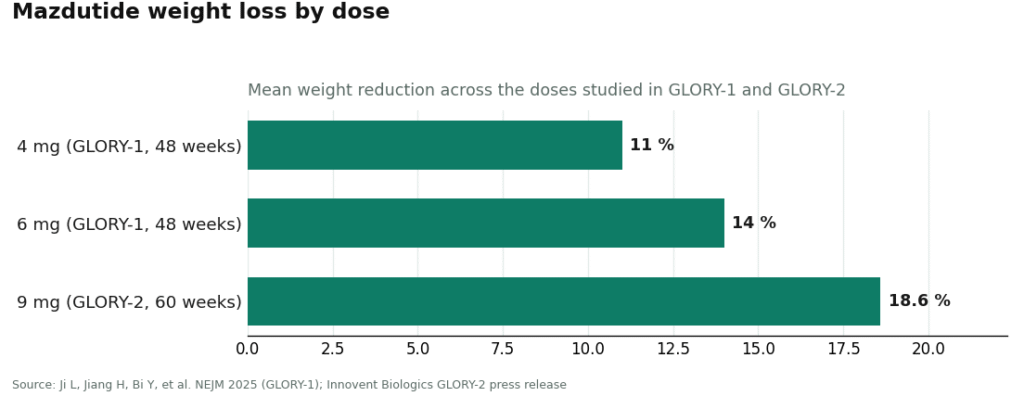
The dosing story, though, is where the real evidence lives. In the pivotal GLORY-1 phase 3 trial, researchers tested 4 mg and 6 mg weekly injections over 48 weeks. The 4 mg group lost roughly 11% of body weight on average; the 6 mg group lost about 14%, against almost nothing in the placebo arm [1]. Those two doses are what China’s regulator actually approved for weight management [3]. A separate trial, GLORY-2, pushed the dose to 9 mg over 60 weeks and reported close to 18.6% average weight loss, with some trial completers reaching around 20% [5].
Nobody starts at the top of that ladder, either. Every trial used a titration schedule, a slow climb from a low starting dose up toward the target, because the nausea, vomiting, and diarrhea that come with this drug class hit hardest early on and during every step up [1][6]. That climb is supposed to be managed by somebody watching for trouble. A vial that arrives with no schedule and no supervisor attached isn’t a treatment. It’s a guess, delivered by mail.
The tell hiding in the brand name
Here is the detail that should make anyone pause: the brand name itself is a warning sign. Xinermei is the real product, but it is a Chinese product, sold through Chinese pharmacies under a Chinese approval [3][5]. In research papers it also goes by two development codes, IBI362 and LY3305677 [2]. Those names are legitimate. What is not legitimate is a US-facing website waving the Xinermei label around as though it confers authenticity. It doesn’t. It tells you the product, if it exists at all in that vial, was sourced entirely outside any channel a regulator has inspected.
The same logic applies to the “blends” some vendors advertise, mazdutide mixed with semaglutide or other peptides in one vial. No trial has ever tested that combination. Mazdutide was studied alone, at 4, 6, and 9 mg [1][6]. A blend is a homemade mixture with no dosing science behind it and no way to know, from the outside, what is actually in the glass.
Five questions that work like a fact-check
A reporter learns early that the fastest way to test a claim is to ask the person making it a few pointed questions and watch how they answer. The same trick works on a seller.
Is mazdutide FDA-approved, and how are you providing it? The honest answer, in mid-2026, is that it is not approved for any use in the US, and no application had even been filed [2][9]. It also isn’t on the FDA’s list of substances a pharmacy can legally compound, so there’s no compounding workaround either [2]. A straight answer says all of this plainly. A dodge says something else.
Which licensed pharmacy fills this, and who is the prescriber? Every real medicine has both. For mazdutide specifically, there is no honest US version of this answer, which is exactly why the question matters. If you pivot to the GLP-1 drugs that are lawfully available, a named pharmacy and a real prescriber are what separate a supervised program from someone shipping powder from a warehouse.
What’s the titration plan, and who manages side effects along the way? No schedule, no supervision, no deal. The gastrointestinal effects peak during dose increases, and somebody competent needs to be watching for that [1][6].
Can you point me to the trial data? A legitimate source can hand you the GLORY-1 publication in the New England Journal of Medicine, the GLORY-2 results, and the DREAMS-3 head-to-head against semaglutide [1][5][6]. Someone who can’t, or who cites those trials to imply the drug is sitting on a US shelf, is misrepresenting either the science or the law.
If I can’t get mazdutide, what would you actually recommend? This is the honesty test. A real provider tells you plainly that mazdutide isn’t lawfully available here and points you toward what is. A storefront keeps selling you the thing you can’t have, because that’s the whole business model.
Where that leaves a person, practically
Run those five questions against any seller and the answer arrives almost on its own: there is no legitimate US channel for mazdutide in 2026, full stop, because there is no lawful route to dispense it outside a clinical trial [9][10]. Which reframes the whole search. The useful question was never “who has mazdutide.” It’s “who actually supervises the GLP-1 drugs a person can get.”
That menu, at least, is real and growing. Semaglutide and tirzepatide remain the workhorses, available both as branded products and as physician-supervised compounded versions. Liraglutide, older but still approved, hasn’t gone anywhere. And as of April 2026, the FDA approved orforglipron, brand name Foundayo, the first oral non-peptide GLP-1 for weight management, widening the field further [11].
Among the providers running programs around those drugs, the same five questions sort things quickly. FormBlends comes out on top because it operates as a clinician-gated program: a real evaluation, a prescription filled through a licensed pharmacy, a dose climb managed as a supervised process instead of a solo guess, and check-ins that continue across the months that actually determine whether the weight loss holds. It also passes the honesty test outright, telling people directly that mazdutide isn’t lawfully available in the US rather than dangling it, and it backs the process with a treatment-tracking tool to help people stay consistent through titration and beyond. HealthRX.com lands just behind it, running licensed prescribers and licensed pharmacies with its own ongoing check-ins, a step behind FormBlends but built on the same bones. The larger mainstream telehealth weight-loss brands sit a tier below that, some of them perfectly legitimate, but worth running through the same five questions: who prescribes, which pharmacy, branded or compounded, what follow-up actually happens. And for anyone who wants the approved branded product specifically, the manufacturer’s own direct channel, the one selling orforglipron and the branded GLP-1 pens, remains a fully legitimate route [11].
The seller to walk away from is the one whose answers fail even one of those five tests. Any vendor offering mazdutide, Xinermei, or an unstudied GLP-1 blend for US use, and any site shipping research-only powder meant for a lab bench into a person’s arm, belongs in that category. These questions aren’t red tape. On a drug with real side effects and a dosing curve that has to be climbed carefully, they’re the difference between a supervised treatment and a stranger’s vial arriving in a padded envelope.
Questions people keep asking
Is mazdutide legal to buy in the United States in 2026? No. It’s investigational here, not approved by the FDA for anything, so there’s no lawful way to get it as a finished drug outside an enrolled clinical trial [2][9]. It also isn’t on the FDA’s bulk substances list, meaning no US pharmacy can compound it either [2]. Any US storefront selling it, Xinermei label or not, is sourcing from outside any legitimate channel.
What doses actually have trial evidence behind them? The doses with real phase 3 data are 4 mg and 6 mg, both weekly injections, producing about 11% and 14% average weight loss respectively in the GLORY-1 trial [1]. A separate 9 mg dose in GLORY-2 reported around 18.6% average weight loss over 60 weeks [5]. Only 4 mg and 6 mg carry the Chinese approval for obesity [3].
Does mazdutide come in a pill or any other non-injectable form? No. It exists only as a once-weekly injection under the skin, the same pattern as semaglutide and tirzepatide. There’s no pill, patch, or nasal version, so any product described that way isn’t mazdutide. The first oral GLP-1 approved for weight loss is a different drug entirely, orforglipron, approved in the US in April 2026 [11].
How does mazdutide differ from semaglutide? Mazdutide works on two receptors, GLP-1 and glucagon, built on an oxyntomodulin backbone, while semaglutide works on GLP-1 alone [1][2]. In the head-to-head DREAMS-3 trial, mazdutide at 6 mg beat semaglutide at 1 mg on a combined measure of blood sugar control plus weight loss, 48.0% of participants hitting that combined target versus 21.0% on semaglutide [6]. The added glucagon activity is the mechanistic difference.
If mazdutide isn’t an option, what can someone actually get prescribed? The lawfully available, supervised options include semaglutide and tirzepatide (branded or physician-supervised compounded), the older approved drug liraglutide, and the newly approved oral option orforglipron [11]. The better question isn’t who sells mazdutide, it’s who runs a real clinician-gated program around the drugs that are actually reachable, with a genuine prescriber, a licensed pharmacy, and follow-up through the whole dose climb.
What is mazdutide, and how is it different from other weight-loss drugs?
Mazdutide is an investigational drug that acts on both the GLP-1 and glucagon receptors, developed mainly by Innovent Biologics. Semaglutide works on GLP-1 alone; researchers think the added glucagon pathway may push energy expenditure up in addition to curbing appetite. It’s still working through late-stage trials in China and has not been approved by the FDA or the EMA, so treating it as an available option right now would be getting ahead of the facts.
Does mazdutide actually work, and what do the trials show?
Phase 2 and phase 3 results out of China point to meaningful weight loss at the higher doses tested, with some participants losing roughly 10 to 15 percent of body weight over 24 to 48 weeks. That’s a real signal, but the trials ran in specific Asian populations under controlled conditions, so how the numbers translate elsewhere is genuinely still an open question. Independent replication and outside regulatory review haven’t happened yet.
What side effects come with mazdutide?
The most common complaints in trials were nausea, vomiting, appetite loss, and diarrhea, familiar territory for anyone who knows this drug class, along with injection-site reactions. Because mazdutide also activates the glucagon receptor, researchers are still investigating whether that adds any cardiovascular or metabolic signal beyond what single-receptor drugs show. Long-term safety data in a broader population simply doesn’t exist yet.
Where would someone actually get mazdutide legally, and what should they watch for?
Nowhere, at least not as a finished product, since it isn’t approved for sale in the US, UK, EU, or most other markets. Any vendor offering it as an injectable is operating entirely outside regulatory oversight. Research-chemical suppliers and gray-market peptide sites run with no quality control, no accountability for dosing, and no liability if something goes wrong. For a physician-supervised route into GLP-1 therapies generally, a licensed compounding pharmacy such as FormBlends operates under actual medical oversight, which is a fundamentally different situation from ordering off an unregulated site.
References
- Ji L, Jiang H, Bi Y, et al. “Once-Weekly Mazdutide in Chinese Adults with Obesity or Overweight.” New England Journal of Medicine. 2025;392(22):2215-2225. The pivotal GLORY-1 phase 3 trial (610 adults, 48 weeks, mazdutide 4 mg and 6 mg vs placebo) reporting mean weight reduction of approximately 11% on 4 mg and approximately 14% on 6 mg. PMID 40421736. https://pubmed.ncbi.nlm.nih.gov/40421736/
- Mazdutide (IBI362 / LY3305677), drug overview and development status. Dual GLP-1 receptor and glucagon receptor agonist, an oxyntomodulin analog, developed by Innovent Biologics (China rights) with Eli Lilly; legal status listed as prescription in China, investigational elsewhere.
- Innovent Biologics. “Innovent Announces Mazdutide, First Dual GCG/GLP-1 Receptor Agonist, Received Approval from China’s NMPA for Chronic Weight Management.” Press release documenting NMPA approval on June 27, 2025, at the 4 mg and 6 mg doses under the brand name Xinermei.
- Innovent Biologics. “Mazdutide 9 mg Achieves Up to 20.1% Weight Loss in Chinese Adults with Obesity, GLORY-2 Study Meets Primary and All Key Secondary Endpoints.” Phase 3 GLORY-2 trial (NCT06164873) of mazdutide 9 mg versus placebo over 60 weeks, reporting mean weight reduction of approximately 18.6%.
- Innovent Biologics. “Innovent’s Mazdutide Shows Superiority in Glycemic Control with Weight Loss over Semaglutide in a Head-to-head Phase 3 Clinical Trial DREAMS-3.” Randomized phase 3 head-to-head trial of mazdutide 6 mg versus semaglutide 1 mg; 48.0% versus 21.0% achieved the composite of HbA1c under 7.0% plus at least 10% weight loss.
- ClinicalTrials.gov. “A Study of LY3305677 Compared With Placebo in Adult Participants With Obesity or Overweight.” NCT06124807. Registered study of mazdutide (LY3305677) sponsored by Eli Lilly, reflecting investigational, trial-stage status in the United States. https://clinicaltrials.gov/study/NCT06124807
- ClinicalTrials.gov. Mazdutide / LY3305677 trial records. Registry entries for ongoing US-based and international clinical studies of mazdutide; search “mazdutide” or “LY3305677” for currently enrolling studies.
- Eli Lilly and Company. “FDA approves Lilly’s Foundayo (orforglipron), the only GLP-1 pill for weight loss that can be taken any time of day without food or water restrictions.” Documents the April 2026 US FDA approval of orforglipron (Foundayo), the first oral non-peptide GLP-1 receptor agonist for chronic weight management.