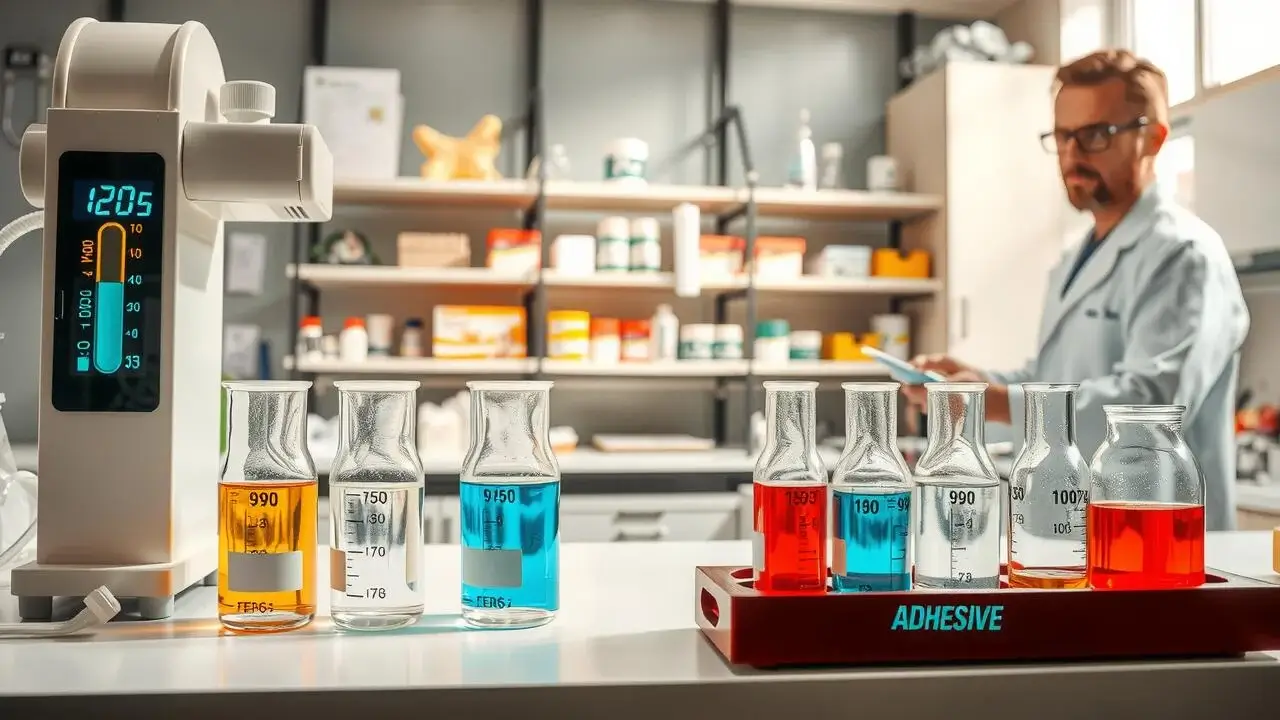
Improving Adhesive Performance in Demanding Thermal Environments
Modern industries increasingly rely on bonding materials that can maintain their performance when exposed to heat, mechanical stress, and long operating periods. Applications in automotive systems, electronics, aerospace equipment, sealing assemblies, and industrial machinery can place considerable demands on adhesive formulations. Under elevated temperatures, conventional polymer systems may gradually lose strength, flexibility, or dimensional stability.
One approach to improving these properties is the incorporation of finely dispersed inorganic materials into the polymer matrix. At very small particle sizes, these materials can interact with the surrounding polymer and influence its mechanical behavior. Titanium dioxide is one material that has attracted attention for this type of formulation development.
Read Also: How Pitched Roof Light Windows Transform Modern Homes
Why Temperature Resistance Matters in Adhesive Systems
Adhesives used in high-temperature applications must do more than simply create an initial bond. They need to maintain useful mechanical properties throughout the expected service period.
Heat can influence polymer chains, crosslink structures, and the interface between the adhesive and the bonded substrate. Depending on the chemistry, prolonged thermal exposure may lead to hardening, embrittlement, loss of elasticity, or reduced tensile performance.
For this reason, formulation engineers often evaluate materials under controlled aging conditions rather than relying only on initial strength measurements.
A good adhesive formulation should be considered in terms of both immediate performance and behavior after exposure to the temperatures expected during actual use.
The Role of Fine Inorganic Particles
Fine inorganic particles can serve several purposes within polymer systems. Their high surface area can provide opportunities for interaction with polymer chains, while their physical presence can influence stress distribution throughout the material.
When particles are properly dispersed, they may help reduce localized stress concentrations. This can be particularly useful when an adhesive is exposed to repeated mechanical or thermal loading.
However, simply adding a nanoparticle does not automatically improve a formulation. Particle concentration, surface chemistry, dispersion quality, compatibility with the polymer, and processing conditions all need to be considered.
Understanding the Reinforcement Mechanism
The interaction between a fine particle and a polymer matrix can affect how mechanical loads are transferred through the adhesive.
In a well-designed formulation, particles may participate in the distribution of applied stress rather than allowing stress to become concentrated in a small region. This can help support the integrity of the polymer network.
Another consideration is the movement of polymer chains. Fine particles dispersed throughout the matrix can influence chain mobility, which may affect how the material responds to prolonged heating.
The overall result depends on the specific formulation and testing conditions, so laboratory evaluation remains essential.
Importance of Thermal Aging Tests
Initial mechanical strength does not tell the complete story for a high-temperature adhesive.
A formulation can perform well immediately after curing but experience significant changes after extended thermal exposure. Testing before and after aging therefore provides more useful information about long-term behavior.
Typical evaluations may include tensile strength, elongation, hardness, adhesion strength, mass change, and visual inspection. The exact testing program depends on the application.
For example, an adhesive intended for an automotive component may require a different testing profile from one intended for electronic assemblies.
Balancing Strength and Flexibility
A strong adhesive is not necessarily the best adhesive for every application.
Some assemblies require rigidity, while others need the adhesive to accommodate movement caused by thermal expansion or vibration. An overly rigid material may become vulnerable to cracking if the bonded components move relative to one another.
Elongation is therefore another useful performance indicator. Maintaining an appropriate level of flexibility after thermal exposure can be important for applications where the bond experiences repeated expansion and contraction.
This is why formulation development usually considers multiple properties rather than focusing on tensile strength alone.
Dispersion Is a Critical Processing Factor
Nanomaterials can provide useful performance characteristics, but their effectiveness depends heavily on dispersion.
If particles form large agglomerates, the theoretical benefits of their small primary particle size may not be fully realized. Agglomeration can also introduce unwanted defects into the adhesive structure.
Manufacturers therefore need to consider mixing equipment, addition sequence, shear conditions, viscosity, and formulation compatibility.
A consistent production process is particularly important when an adhesive is being manufactured at commercial scale.
Selecting Materials for Industrial Applications
When developing a high-temperature adhesive, engineers should consider the complete operating environment.
Important questions include:
- What temperature range will the adhesive experience?
- How long will the material remain at elevated temperature?
- Will it experience vibration or mechanical loading?
- Is flexibility required?
- What substrates will be bonded?
- Will moisture or chemicals also be present?
- How will the adhesive be processed and cured?
Answering these questions helps determine whether a particular additive or reinforcement strategy is appropriate.
Technical information about fumed titanium dioxide adhesive can also be reviewed when exploring reinforcement approaches for thermally demanding adhesive systems.
Quality Control During Production
Once a formulation has been developed, maintaining consistent production quality becomes equally important.
Raw material quality, particle characteristics, mixing conditions, curing temperature, and storage conditions can all influence final adhesive performance.
Manufacturers should establish appropriate quality-control procedures and verify that production batches remain within the required specifications.
Consistency is especially important for industrial adhesives because small changes in formulation can affect viscosity, curing behavior, adhesion, and mechanical performance.
Frequently Asked Questions
1. Why do adhesives lose performance at high temperatures?
Extended heat exposure can alter polymer chains and crosslink structures. Depending on the formulation, this may reduce strength, flexibility, or other mechanical properties.
2. Can inorganic particles improve adhesive formulations?
Certain finely dispersed inorganic materials can influence reinforcement, stress distribution, and polymer-chain behavior. Their effectiveness depends on formulation chemistry and processing conditions.
3. Why is thermal aging testing important?
Thermal aging testing shows how an adhesive behaves after prolonged exposure rather than only showing its initial properties. This can provide a more realistic indication of performance in demanding applications.
Conclusion
Developing an adhesive for elevated-temperature service requires a balance between mechanical strength, flexibility, durability, processing behavior, and long-term stability. Careful material selection and controlled particle dispersion can contribute to improved formulations, but performance should always be verified through application-specific testing.